
And Yet, We're Still Here

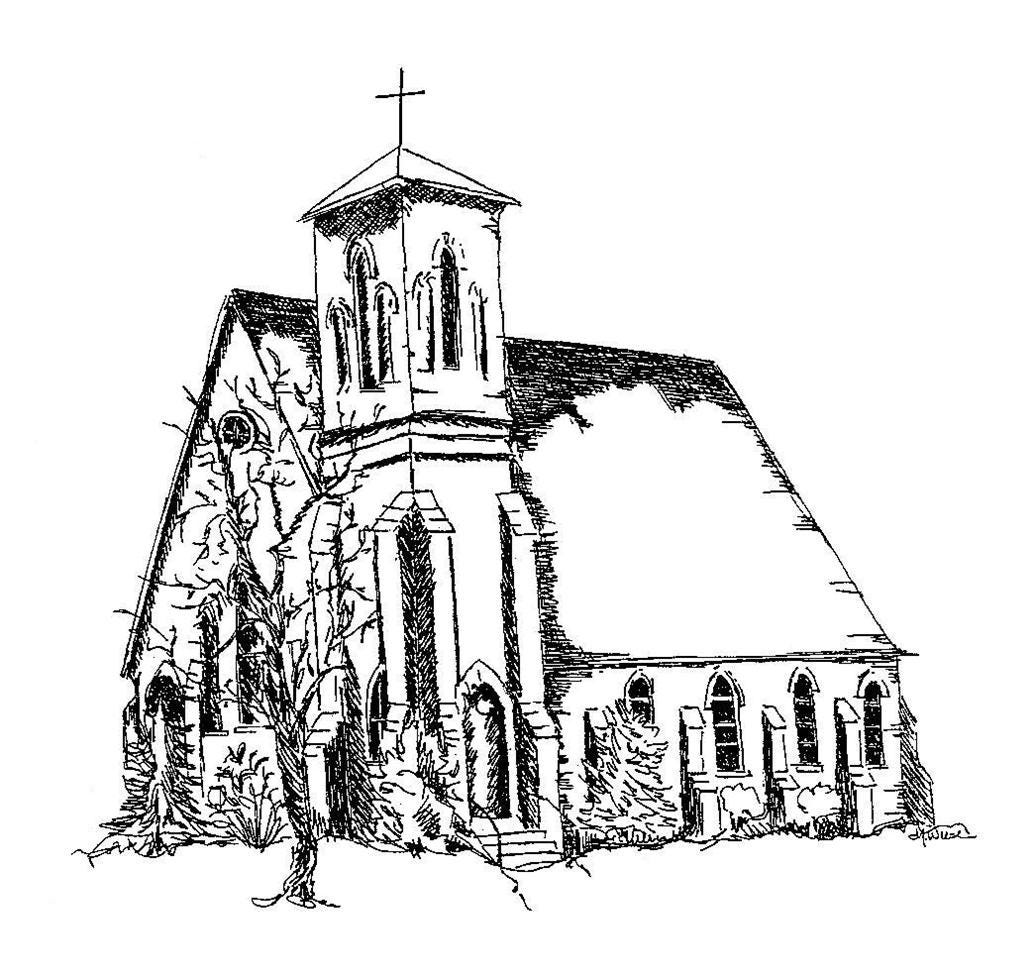
This sermon was preached on 4/26/26 at St. James’ Episcopal Church in Goshen. The previous day was the 167th anniversary of the parish’s founding. As part of our celebration, we worshipped according to the 1789 Book of Common Prayer then in use by the Episcopal Church.
On April 25, 1859, the day after Easter Sunday, the Rev. William H Stoy of Lima, Indiana, led the formal establishment of St. James Episcopal Church, and the election of our first Sr. and Jr. Wardens. This grew from a meeting Rev. Stoy (Father hadn’t yet become a common title for Episcopalian clergy) held at the office of George Howell almost a month before where the terms for founding the parish were decided. We started worshiping at a Swedenborgian Meeting House and requested that the Rev. Henry M. Thompson, the rector at St. John’s in Bristol, preach every other Sunday. We called our first rector the following year.
I wish I could ask our forebearers in faith what issues pressed on their minds when they came together to found St. James. In 1859, the United States was on the verge of the Civil War. Militant abolitionist John Brown’s failed raid on Harper’s Ferry, by which he intended to spark an armed slave revolt happened in October of that year. Lincoln would be elected the following year, leading Southern states to secede from the Union, with war breaking out with the attack on Fort Sumter on April 12, 1861.
Did the rising tensions factor into the decisions of the new parish at all?
Or was it the furthest thing from their mind?
What we do know is that in 1860, St. James called the Rev. Dr. Colley A. Foster as its first rector and laid the cornerstone for the building we are worshiping in now. On December 4, 1862, Bishop George Upfold, the first Bishop of the still-new Diocese of Indiana, consecrated this building. Normally, we would have had to wait until we paid off our debt for the construction, but Bishop Upfold waved this requirement because of the “prosperous condition of the parish.”
For our first two decades, the interior of our building and our style of worship looked very different from today. The Oxford movement, which revitalized Anglicans’ appreciation for the beauty of worship and our continuity with the pre-Reformation Western Church and gave birth to modern Anglo-Catholicism, only started in the 1830s and was still making its way across the pond.
The early bishops of Indiana were old-school High Churchmen who appreciated liturgical insights of the Oxford Movement but opposed adopting what they saw as Roman practices and doctrines. (As an aside, the terms high church and low church originally referred to factions within the Anglican Church, before they started being used to describe the spectrum of Christian denominations.) Bishop Upfold, who was oft quoted as saying “the worship was the adornment,” refused to lead worship in parishes that had flowers in the chancel!
And, from the descriptions I’ve read, our original chancel reflected his convictions. There was a low platform up front, with some chairs for the clergy and servers, and a reading desk for both scripture reading and preaching. On Communion Sundays, which for most parishes at this time were every six weeks, a freestanding holy table was placed under the windows. There were no altar rails, reredos, tabernacle, pulpit, or even a baptismal font.
Clergy of the era usually wore what is called choir dress during services, which is what I am wearing now, instead of traditional Eucharistic vestments.
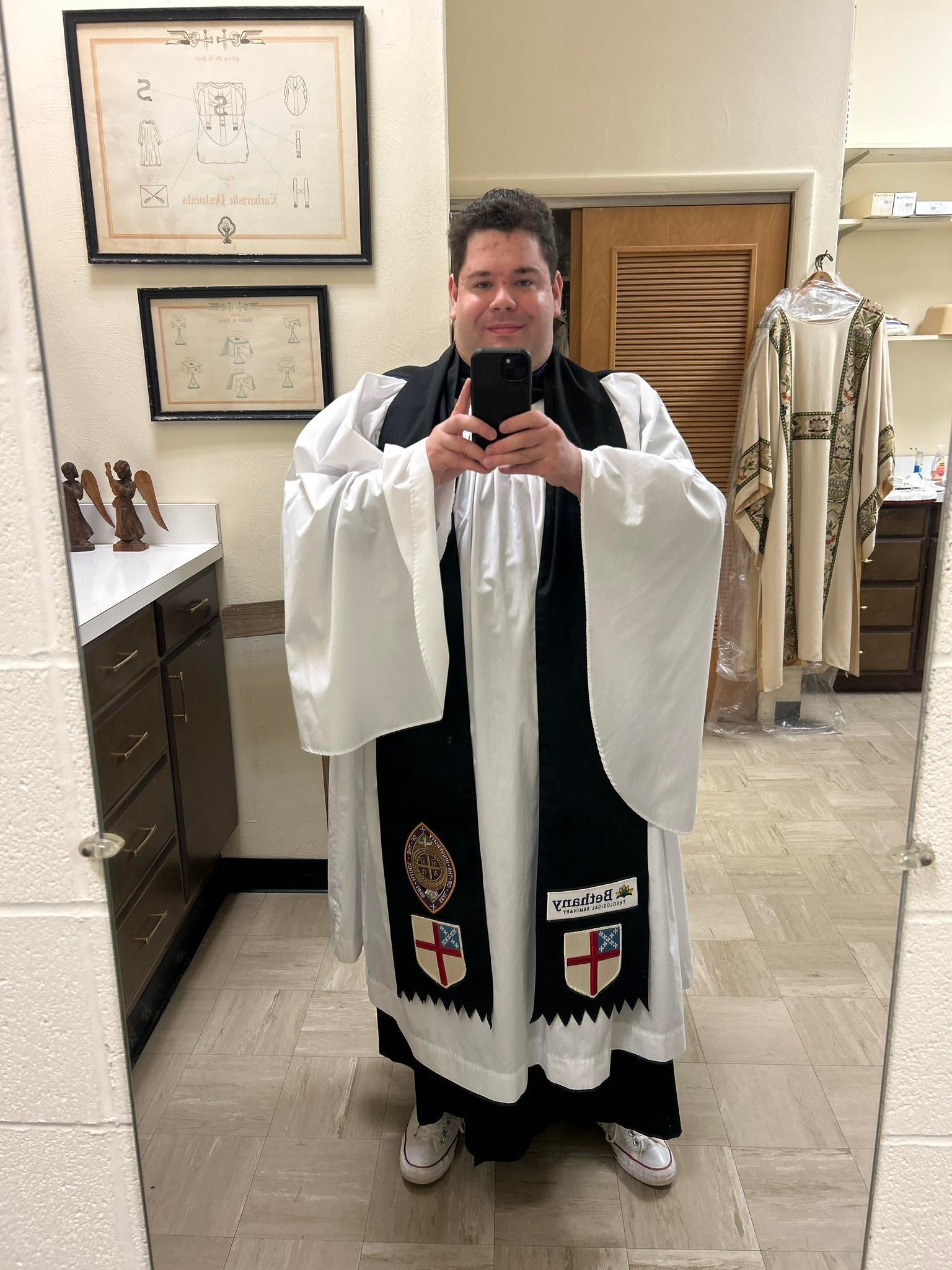
Me in choir dress. In the 1850’s, I probably wouldn’t have seals (patches) on my tippet (black preaching scarf) and would be wearing preaching bands. I might even change into a black preaching gown during my sermon. Today, choir dress is usually worn by Episcopalians during non-sacramental services such as the Daily Office, or, with a stole instead of a tippet, by clergy at a major service such as an ordination where they are not serving in the liturgy.
And if we were really trying to re-create an 1850’s-style service, we would have prayed Morning Prayer and the Great Litany together, before starting the order for Holy Communion, and this sermon would last for at least an hour. So, is everybody comfortable?
I don’t think I could preach that long if I tired.
On Sundays when Communion wasn’t celebrated, the service would have ended after what we now call the liturgy of the word. Despite the early prosperity that convinced Bishop Upfold to dedicate our building early, St James’s has had what my predecessor Fr. Robert J. M. Goode called in the 1970s a “old tradition” of financial struggles.
Many of our early priests only stayed in Goshen for a few years as the parish struggled to pay them. As early as 1880, the vestry passed a motion to sell the building, and when we struggled to find a rector considered merging with St. John’s. (The account I found didn’t specify if they meant St. John’s Elkhart or St. John’s Bristol, as the parishes didn’t choose different St. Johns as patrons until much later.)
And yet, we are still here.
In 1944, Fr. Bruce Mosier began serving St. James as a deacon. Ordained to the priesthood in 1946, he briefly served parishes in Elkhart and Warsaw before asking Bishop Mallett to send him back to Goshen. The bishop is said to have replied “I’ll send you to Goshen, Mosier, but when you’re ready to close it, be sure to mail me the key.”
And yet we are still here.
God had a plan for St. James in 1859, and God has a plan for us now. There is a reason we are still here 167 years later.
I’m not going to claim that I know exactly what God’s plan for the next 167 years looks like. But I see the seeds of something new sprouting all around us.
We have welcomed the scouts to come alongside us in serving our community. There are people in the pews who weren’t here a year ago. And next week, Fr. Jerry and Deacon Edith will lead our first Spanish Eucharist as we begin our Spanish-language ministry.
We may not know what the future will bring, but God is preparing us even now for the new movements of the Holy Spirit.
Our spiritual ancestors had faith and trusted that God was doing something new 167 years ago when they planted St. James’s parish.
May we have that same faith and trust as we steward St. James’ into the future.
Amen.
Interesting history, thanks for sharing it. Ellie T.